
Skip to Content
chevron-left chevron-right chevron-up chevron-right chevron-left arrow-back star phone quote checkbox-checked search wrench info shield play connection mobile coin-dollar spoon-knife ticket pushpin location gift fire feed bubbles home heart calendar price-tag credit-card clock envelop facebook instagram twitter youtube pinterest yelp google reddit linkedin envelope bbb pinterest homeadvisor angies

Top 10 Grounding Accessories for Global Buyers

Global buyers need more than a long product list when selecting Grounding Accessories. They need dependable protection, clear technical evidence, and compatibility with local installation practices. A copper-clad ground rod may look suitable in a catalog, yet soil chemistry, moisture, and corrosion can change its performance. Small details matter.

Electrical educator Mike Holt states, “Electricity will always take the path of least resistance.” This principle explains why grounding clamps, bonding jumpers, earth bars, inspection wells, and conductor connectors must work as one system. A weak connection can increase resistance, create dangerous touch voltages, or fail during a lightning event. Grounding is not merely a purchasing category.

This guide examines ten practical Grounding Accessories for international buyers. It considers material quality, mechanical strength, corrosion resistance, installation effort, and inspection access. It also highlights useful references, including IEC 62561, UL 467, and applicable national electrical codes. Certification should be verified, not assumed. Supplier test reports, batch traceability, and installation instructions deserve close attention.

Real projects are rarely perfect. Soil conditions may differ across one site. Delivery documents can also contain unclear specifications. Buyers should question vague claims and request measurable data. A product that performs well in dry soil may disappoint in coastal conditions. The best choice depends on the complete grounding design, not the lowest unit price.

Some recommendations may require adjustment after field testing. That is acceptable. Reliable sourcing includes review, measurement, and honest reassessment. With careful comparison, global buyers can select accessories that support safer installations, easier maintenance, and more predictable long-term performance.
Top 10 Grounding Accessories for Global Buyers

Grounding Accessories: Purpose, Types, and Basic Terminology

Top 10 Grounding Accessories for Global Buyers

Grounding accessories create a safe path for fault current, lightning, and unwanted electrical energy. The basic terminology matters. An electrode connects equipment to earth. Bonding joins conductive parts together. A grounding conductor links equipment to the grounding system. Earthing is commonly used in international specifications. IEC 60364-4-41 emphasizes automatic disconnection and effective protective conductors. NFPA reported 1,388,500 U.S. fires in 2023, with about $22.2 billion in property damage. Grounding cannot prevent every incident, but poor grounding can increase electrical risk.

Common accessories include grounding rods, plates, clamps, bonding jumpers, copper conductors, cable lugs, grounding bars, test links, inspection pits, and ground-enhancement compounds. Surge protective devices also depend on a low-impedance grounding path. IEEE Std 80 connects grounding-grid performance with soil resistivity, touch voltage, step voltage, and fault-clearing time. In practice, a shiny clamp is not enough. Corrosion, loose connections, and unsuitable metals can quietly weaken protection. This part is often underestimated.

Tips: Ask for material grades, conductor sizes, certification documents, and test records. Confirm compatibility between copper, galvanized steel, and aluminum before installation. Measure earth resistance under site conditions, not only in a factory report. Local soil can be dry, rocky, or unexpectedly corrosive. A complete design should follow the destination market’s electrical rules. Mistakes happen, even in experienced teams. Recheck the drawings.

The Ten Essential Grounding Accessories for Different Applications

Top 10 Grounding Accessories for Global Buyers

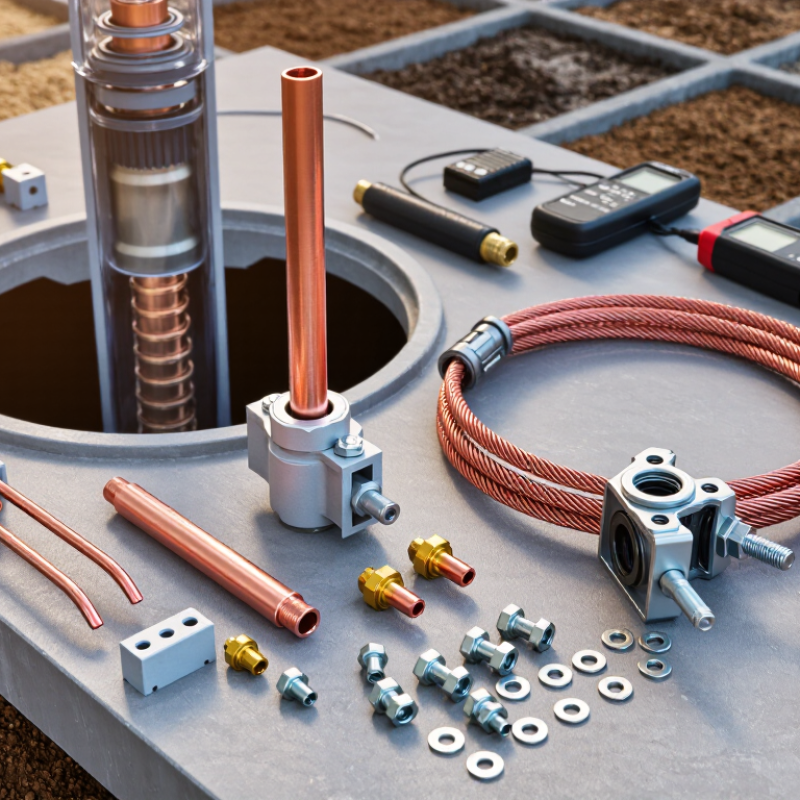
The ten essential grounding accessories support different applications, from household equipment to industrial power systems. Grounding clamps secure conductors to rods, pipes, or structural steel. Copper grounding rods provide a reliable path into soil. Bonding jumpers connect metal parts and reduce dangerous voltage differences.

Grounding lugs attach cables to panels and enclosures. Grounding busbars organize several connections inside electrical cabinets. Flexible grounding straps suit moving doors, machinery, and vibration-prone equipment. Inspection pits allow technicians to check rod connections without disturbing the surrounding ground. Earthing mats help protect workers near temporary electrical installations. Conductive backfill compounds can improve contact in dry or rocky soil. Surge protection grounding conductors guide excess energy away from sensitive equipment.

Tips: Match each accessory with the conductor size, material, corrosion risk, and local installation rules. Measure twice. Moisture changes everything.

In practice, experienced installers inspect contact surfaces before tightening clamps. Paint, rust, and loose hardware can weaken a connection. Stainless hardware may perform better in humid coastal areas, while copper components often suit general installations. However, material compatibility deserves attention because dissimilar metals can accelerate corrosion. A product may look substantial but still fail under poor soil conditions. Testing resistance after installation provides stronger evidence than appearance alone. I have found that simple layouts are easier to inspect, although compact designs sometimes save space. Review access, maintenance needs, and environmental exposure before selecting the final combination.

Top 10 Grounding Accessories for Global Buyers

Typical application coverage for ten essential grounding accessories. A value of 1 indicates that the accessory is commonly used in that application; 0 indicates that it is not typically a primary selection.

Selection should be confirmed against local electrical codes, soil conditions, fault-current requirements, conductor size, and the specific installation environment.

How to Compare Materials, Performance, and Product Compatibility

Top 10 Grounding Accessories for Global Buyers

When comparing grounding accessories, material selection should match soil, current, and installation conditions. Copper grounding rods offer excellent conductivity, while galvanized steel can reduce costs in less corrosive environments. Stainless steel performs better near saltwater, but its price is higher. Check galvanic compatibility before joining different metals.

The main accessories include grounding rods, clamps, bonding jumpers, lugs, busbars, grounding wire, inspection wells, earth-enhancement compounds, exothermic welding kits, and surge-protection grounding modules. NFPA research estimates that electrical distribution and lighting equipment caused about 32,000 U.S. home fires annually from 2016 to 2020. Reliable connections matter. Look for tested current capacity, pull-out strength, corrosion resistance, and stable contact pressure. IEC 60364-5-54 also emphasizes protective bonding and suitable earthing arrangements for electrical installations.

Performance claims need careful checking. A thick rod is not automatically better. Soil moisture, electrode depth, and connection quality can change resistance dramatically. Field testing with a calibrated earth tester is more useful than relying on catalog figures. Exothermic connections usually provide durable joints, but they require trained installation and accurate mold selection. I have seen inexpensive clamps loosen after repeated thermal cycling. That mistake is easy to miss. Buyers should request material certificates, salt-spray results, test reports, and compatibility tables. Some suppliers provide impressive numbers without stating test conditions. That deserves a second look.

Global Safety Standards, Certifications, and Installation Requirements

Top 10 Grounding Accessories for Global Buyers

Grounding rods, clamps, conductors, bonding jumpers, and cable lugs form the core of many earthing systems. Grounding busbars, test links, inspection pits, exothermic welding kits, and surge protection connections complete the accessory range. Each part must match the installation environment, conductor size, fault current, and expected service life. Small mismatches can create dangerous resistance.

Global buyers should request technical files, material specifications, batch traceability, and clear installation instructions. Relevant references may include IEC 60364 for low-voltage installations and IEC 62561 for lightning protection components. Some markets also require national approvals, such as electrical safety certification or recognized testing under local codes. A conformity mark alone is not enough. Check its scope, issuing body, and validity.

Installation quality matters more than appearance. Measure soil resistivity before selecting rod length or quantity. Remove oxidation from contact surfaces, apply suitable corrosion protection, and tighten connections to the specified torque. Keep bonding paths short, direct, and mechanically protected. Inspection pits should remain accessible for testing. Field teams sometimes bury test links permanently, which makes future verification difficult. Even experienced installers can overlook dissimilar-metal corrosion. A documented inspection, continuity test, and earth resistance report provide stronger evidence than photographs alone. Local regulations still control the final design.

A Practical Buying Guide for International Grounding Accessory Sourcing

Top 10 Grounding Accessories for Global Buyers

International grounding accessory sourcing needs more than a low quotation. MarketsandMarkets’ 2024 Grounding Equipment Market report projects about 7% annual growth through 2029. This reflects wider demand from power, construction, and industrial projects. A practical shortlist includes copper-bonded ground rods, stainless-steel rods, rod clamps, bonding jumpers, grounding lugs, earth bars, inspection pits, earthing conductors, exothermic welding kits, and ground-resistance testers. Each item should match the project’s soil conditions, fault current, and installation method.

IEC 60364-5-54 gives important guidance on protective conductors and earthing arrangements. IEEE Std 81 supports soil-resistivity and grounding-system measurements. Buyers should request material certificates, coating thickness, dimensions, mechanical strength, and independent test records. A certificate alone is not enough. Check whether the test method matches the destination project. Also verify corrosion performance for coastal, wet, or chemically exposed sites. Small differences matter.

In field purchasing, mixed-metal connections often create hidden corrosion risks. Specify compatible metals and suitable joint compounds. Ask for clear drawings, packing photos, and batch traceability before shipment. Ground-resistance testers need calibration evidence, not just a product brochure. Packaging deserves attention too. Bent rods and cracked inspection pits create expensive delays. One weakness remains: many buyers compare unit prices but ignore installation labor and replacement risk. I would also recheck local technical requirements with a qualified engineer, because a globally accepted accessory may still be unsuitable for one site.